Articles by "AppPhysics Lectures"

Applied Physics Lecture: Fluids

Lesson Objectives - the students should be able to:

  • Distinguish between density, weight density, and specific gravity and given an object's mass and volume, calculate the object's density, weight density, and specific gravity.
  • Define pressure and calculate the pressure that an object of known weight exerts on a surface of known area and express the magnitude of the pressure in psi, lb/ft2, N/m2, or pascals (Pa).
  • Calculate the pressure acting at a depth h below the surface of a liquid of density (ρ).
  • Distinguish between absolute pressure and gauge pressure and solve problems involving each type of pressure.
  • State Pascal's Principle and apply this principle to basic hydraulic systems.
  • State Archimedes Principle and use this principle to solve problems related to buoyancy.
  • Explain what is meant by streamline flow, the equation of continuity, and the flow rate. Apply these concepts to word problems to solve for the velocity of water at a particular point in a closed pipe.
  • Use Bernoulli's equation and the concept of streamline flow to solve for the velocity of a fluid and/or the pressure exerted by a fluid at a particular point in a closed pipe.

Lecture on Fluids PPT


Back to Homepage

Summary of Chapter 10

  • Phases of matter: solid, liquid, gas.
  • Liquids and gases are called fluids.
  • Density is mass per unit volume.
  • Specific gravity is the ratio of the density of the material to that of water.
  • Pressure is force per unit area.
  • Pressure at a depth h is ρgh.
  • External pressure applied to a confined fluid is transmitted throughout the fluid.
  • Atmospheric pressure is measured with a barometer.
  • Gauge pressure is the total pressure minus the atmospheric pressure.
  • An object submerged partly or wholly in a fluid is buoyed up by a force equal to the weight of the fluid it displaces.
  • Fluid flow can be laminar or turbulent.
  • The product of the cross-sectional area and the speed is constant for horizontal flow.
  • Where the velocity of a fluid is high, the pressure is low, and vice versa.
  • Viscosity is an internal frictional force within fluids.
  • Liquid surfaces hold together as if under tension.

Units of Chapter 10 - Keywords

  • Density and Specific GravityDensity and Specific Gravity
  • Density and Specific Gravity
  • Pressure in Fluids
  • Atmospheric Pressure and Gauge Pressure
  • Pascal’s Principle
  • Measurement of Pressure; Gauges and the Barometer
  • Buoyancy and Archimedes’ Principle
  • Fluids in Motion; Flow Rate and the Equation of Continuity
  • Bernoulli’s Equation
  • Applications of Bernoulli’s Principle: from Torricelli to Airplanes, Baseballs, and TIA
  • Viscosity
  • Flow in Tubes: Poiseuille’s Equation, Blood Flow
  • Surface Tension and Capillarity
  • Pumps, and the Heart

List of Applied Physics / Physics 2 Lectures

Download Lecture


credit: Giancoli Physics©2013 www.PinoyBIX.org

Applied Physics Lecture: Electric Currents

Lesson Objectives - the students should be able to:

  • Explain how a simple battery can produce an electrical current.
  • Define current, ampere, emf, voltage, resistance, resistivity, and temperature coefficient of resistance.
  • Write the symbols used for electromotive force, electric current, resistance, resistivity, temperature coefficient of resistance and power and state the unit associated with each quantity.
  • Distinguish between a) conventional current and electron current and b) direct current and alternating current.
  • Know the symbols used to represent a source of emf, resistor, voltmeter, and ammeter and how to interpret a simple circuit diagram.
  • Given the length, cross sectional area, resistivity, and temperature coefficient of resistance, determine a wire's resistance at room temperature and some higher or lower temperature.
  • Solve simple dc circuit problems using Ohm's law.
  • Use the equations for electric power to determine the power and energy dissipated in a resistor and calculate the cost of this energy to the consumer.
  • Distinguish between the rms and peak values for current and voltage and apply these concepts in solving problems involving a simple ac circuit.
  • Compute Power in Household Circuits
  • Understand the Microscopic View of Electric Current
  • Learn the concept of Superconductivity
  • Could understand the Electrical Conduction in the Human Nervous System

Lecture on Electric Currents PPT


Back to Homepage

Summary of Chapter 18

  • A battery is a source of constant potential difference.
  • Electric current is the rate of flow of electric charge.
  • Conventional current is in the direction that positive charge would flow.
  • Resistance is the ratio of voltage to current:
    Resistance Formula:
  • Ohmic materials have constant resistance, independent of voltage.
  • Resistance is determined by shape and material:
    Resistance is determined by shape and material:
  • ρ is the resistivity.
  • Power in an electric circuit:
    Power in an electric circuit:
  • Direct current is constant
  • Alternating current varies sinusoidally
    Alternating current varies sinusoidally
  • The average (rms) current and voltage:
    The average (rms) current and voltage:
  • Relation between drift speed and current:
    Relation between drift speed and current:

Units of Chapter 18 - Keywords

  • The Electric Battery
  • Electric Current
  • Ohm’s Law: Resistance and Resistors
  • Resistivity
  • Electric Power
  • Power in Household Circuits
  • Alternating Current
  • Microscopic View of Electric Current
  • Superconductivity
  • Electrical Conduction in the Human Nervous System
  • Volta
  • electrolyte

List of Applied Physics / Physics 2 Lectures

Download Lecture


credit: Giancoli Physics©2013 www.PinoyBIX.org

Applied Physics Lecture: Electric Potential

Lesson Objectives - the students should be able to:

  • Write from memory the definitions of electric potential, and electric potential difference.
  • Distinguish between electric potential, electric potential energy, and electric potential difference.
  • Draw the electric field pattern and equipotential line pattern which exist between charged objects.
  • Determine the magnitude of the potential at a point a known distance from a point charge or an arrangement of point charges.
  • State the relationship between electric potential and electric field and determine the potential difference between two points a fixed distance apart in a region where the electric field is uniform.
  • Determine the kinetic energy in both joules and electron volts of a charged particle which is accelerated through a given potential difference.
  • Explain what is meant by an electric dipole and determine the magnitude of the electric dipole moment between two point charges.
  • Given the dimensions, distance between the plates, and the dielectric constant of the material between the plates, determine the magnitude of the capacitance of a parallel plate capacitor.
  • Given the capacitance, the dielectric constant, and either the potential difference or the charge stored on the plates of a parallel plate capacitor, determine the energy and the energy density stored in the capacitor.
  • Understand the functions and operations of Cathode Ray Tube: TV and Computer Monitors, Oscilloscope
  • Know The Electrocardiogram (ECG or EKG)

Lecture on Electric Potential PPT


Back to Homepage

Summary of Chapter 17

  • Electric potential energy:
    Electric potential energy:
  • Electric potential difference: work done to move charge from one point to another
  • Relationship between potential difference and field:
    Relationship between potential difference and field:
  • Equipotential: line or surface along which potential is the same
  • Electric potential of a point charge:
    Electric potential of a point charge:
  • Electric dipole potential:
    Electric dipole potential:
  • Capacitor: nontouching conductors carrying equal and opposite charge
  • Capacitance:
    Capacitance Formula:
  • Capacitance of a parallel-plate capacitor:
    Capacitance of a parallel-plate capacitor:
  • A dielectric is an insulator
  • Dielectric constant gives ratio of total field to external field
  • Energy density in electric field:
    Energy density in electric field:

Units of Chapter 17 - Keywords

  • Electric Potential Energy and Potential Difference
  • Relation between Electric Potential and Electric Field
  • Equipotential Lines
  • The Electron Volt, a Unit of Energy
  • Electric Potential Due to Point Charges
  • Potential Due to Electric Dipole; Dipole Moment
  • Capacitance
  • Dielectrics
  • Storage of Electric Energy
  • Cathode Ray Tube: TV and Computer Monitors, Oscilloscope
  • The Electrocardiogram (ECG or EKG)

List of Applied Physics / Physics 2 Lectures

Download Lecture


credit: Giancoli Physics©2013 www.PinoyBIX.org

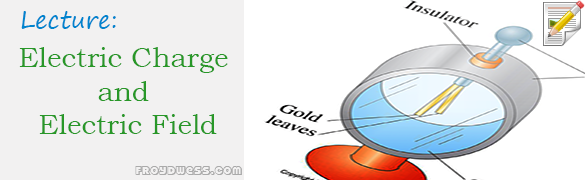
Applied Physics Lecture: Electric Charge and Electric Field

Lesson Objectives - the students should be able to:

  • State from memory the magnitude and sign of the charge on an electron and proton and also state the mass of each particle.
  • Apply Coulomb's law to determine the magnitude of the electrical force between point charges separated by a distance r and state whether the force will be one of attraction or repulsion.
  • State from memory the law of conservation of charge.
  • Distinguish between an insulator, a conductor, and a semi conductor and give examples of each.
  • Explain the concept of electric field and determine the resultant electric field at a point some distance from two or more point charges.
  • Determine the magnitude and direction of the electric force on a charged particle placed in an electric field.
  • Sketch the electric field pattern in the region between charged objects.
  • Use Gauss's law to determine the magnitude of the electric field in problems where static electric charge is distributed on a surface which is simple and symmetrical.
  • Could understand Static Electricity; Electric Charge and Its Conservation
  • Solving Problems Involving Coulomb’s Law and Vectors
  • Learn Electric Forces in Molecular Biology: DNA Structure and Replication
  • Understand Photocopy Machines and Computer Printers Use Electrostatics

Lecture on Electric Charge and Electric Field PPT


Back to Homepage

Summary of Chapter 16

  • Two kinds of electric charge – positive and negative
  • Charge is conserved
  • Charge on electron:
    Charge on electron
  • Conductors: electrons free to move
  • Insulators: nonconductors
  • Charge is quantized in units of e
  • Objects can be charged by conduction or induction
  • Coulomb’s law:
    Coulomb’s law
  • Electric field is force per unit charge:
    Electric field Formula
  • Electric field of a point charge:
    Electric field of a point charge
  • Electric field can be represented by electric field lines
  • Static electric field inside conductor is zero; surface field is perpendicular to surface
  • Electric flux:
    Electric flux formula
  • Gauss’s law:
    Gauss’s law

Units of Chapter 16 - Keywords

  • Static Electricity; Electric Charge and Its Conservation
  • Electric Charge in the Atom
  • Insulators and Conductors
  • Induced Charge; the Electroscope
  • Coulomb’s Law
  • Solving Problems Involving Coulomb’s Law and Vectors
  • The Electric Field
  • Field Lines
  • Electric Fields and Conductors
  • Gauss’s Law
  • Electric Forces in Molecular Biology: DNA Structure and Replication
  • Photocopy Machines and Computer Printers Use Electrostatics

List of Applied Physics / Physics 2 Lectures

Download Lecture


credit: Giancoli Physics©2013 www.PinoyBIX.org

The Laws of Thermodynamics

Lesson Objectives - the students should be able to:

  • Explain what is meant by a physical system and distinguish between an open system and a closed system.
  • State the first law of thermodynamics and use this law to solve problems.
  • Distinguish between an isothermal process, isobaric process, isochoric process and adiabatic process and draw a PV diagram for each process.
  • Calculate the work done by a gas from a PV diagram. Use the equations for an ideal gas and for the internal energy of a gas to calculate the change in internal energy of a gas and the heat added or removed during a thermodynamic process.
  • Calculate the amount of heat which must be added or removed to change the temperature of a gas held in a closed container under conditions of constant volume or constant pressure.
  • Write from memory and explain the meaning of three equivalent ways of stating the second law of thermodynamics.
  • Use the first and second laws of thermodynamics to solve problems involving a Carnot engine.
  • Distinguish between a reversible process and an irreversible process. Give examples of each type of process.
  • Determine the change in entropy for a system in which the thermodynamic process is either reversible or irreversible.
  • Distinguish between macrostate and microstate and solve problems involving the statistical interpretation of entropy.

Lecture on The Laws of Thermodynamics PPT


Back to Homepage

Summary of Chapter 15

  • First law of thermodynamics:
    First law of thermodynamics Formula
  • Isothermal process: temperature is constant.
  • Adiabatic process: no heat is exchanged.
  • Work done by gas at constant pressure:
    Work done by gas Formula
  • Heat engine changes heat into useful work; needs temperature difference.
  • Efficiency of a heat engine:
    Efficiency of a heat engine Formula
  • Upper limit on efficiency:
    Upper limit on efficiency Formula
  • Refrigerators and air conditioners do work to extract heat from a cooler region and send it to a warmer region:
    Refrigerators and air conditioners do work
  • A heat pump is similar:
    heat pump Formula
  • Second law of thermodynamics:
    • heat flows spontaneously from a hot object to a cold one, but not the reverse
    • a given amount of heat cannot be changed entirely to work
    • natural processes tend to increase entropy.
  • Change in entropy:
    Change in entropy Formula
  • Entropy is a measure of disorder.
  • As time goes on, less and less energy is available to do useful work.

Units of Chapter 15 - Keywords

  • The First Law of Thermodynamics
  • Thermodynamic Processes and the First Law
  • Human Metabolism and the First Law
  • The Second Law of Thermodynamics – Introduction
  • Heat Engines
  • Refrigerators, Air Conditioners, and Heat Pumps
  • Entropy and the Second Law of Thermodynamics
  • Order to Disorder
  • Unavailability of Energy; Heat Death
  • Evolution and Growth; “Time’s Arrow”
  • Statistical Interpretation of Entropy and the Second Law
  • Thermal Pollution and Global Warming

Download Lecture Handout


credit: Giancoli Physics©2013 www.PinoyBIX.org

Applied Physics Lecture: Heat

Lesson Objectives - the students should be able to:

  • Convert from joules to calories and kilocalories and vice versa.
  • Distinguish between the concepts of temperature and heat.
  • Explain what is meant by specific heat, latent heat of fusion, and latent heat of vaporization.
  • Apply the law of conservation of energy to problems involving calorimetry.
  • Distinguish the three ways that heat transfer occurs: conduction, convection, and radiation.
  • Solve problems involving the rate of heat transfer by convection and radiation.

Lecture on Heat PPT


Back to Homepage

Summary of Chapter 14

  • Internal energy U refers to the total energy of all molecules in an object. For an ideal monatomic gas,
    Ideal gas law Formula
  • Heat is the transfer of energy from one object to another due to a temperature difference. Heat can be measured in joules or in calories.
  • Specific heat of a substance is the energy required to change the temperature of a fixed amount of matter by 1° C.
  • In an isolated system, heat gained by one part of the system must be lost by another.
  • Calorimetry measures heat exchange quantitatively.
  • Phase changes require energy even though the temperature does not change.
  • Heat of fusion: amount of energy required to melt 1 kg of material.
  • Heat of vaporization: amount of energy required to change 1 kg of material from liquid to vapor.
  • Heat transfer takes place by conduction, convection, and radiation.
  • In conduction, energy is transferred through the collisions of molecules in the substance.
  • In convection, bulk quantities of the substance flow to areas of different temperature.
  • Radiation is the transfer of energy by electromagnetic waves.

Units of Chapter 14 - Keywords

  • Heat As Energy Transfer
  • Internal Energy
  • Specific Heat
  • Calorimetry – Solving Problems
  • Latent Heat
  • Heat Transfer: Conduction
  • Heat Transfer: Convection
  • Heat Transfer: Radiation

Download Lecture Handout


credit: Giancoli Physics©2013 www.PinoyBIX.org

Applied Physics Lecture: Temperature and Kinetic Theory

Lesson Objectives - the students should be able to:

  • Convert a temperature given in degrees Fahrenheit to degrees Celsius and/or degrees Kelvin, and vice versa.
  • State the factors that cause the volume of a solid or liquid to change or the length of a solid to change. Also, solve word problems and determine the final length or volume.
  • Write the mathematical relationships that summarize Boyle's law, Charles law, Gay Lussac's law, and the ideal gas equation. Use these equations to solve word problems.
  • State in your own words Avogadro's hypothesis. State from memory the modern value of Avogadro's number.
  • State the postulates of the kinetic theory of gases.
  • Rewrite the ideal gas equation in terms of motion of the molecules of an ideal gas.
  • Explain what is meant by the term rms velocity.
  • Explain what is meant by Van der Waal's forces.
  • Given a phase diagram for water, determine the range of temperature and pressure at which water is a solid, liquid, or gas. Describe what is meant by the triple point of water and point out the triple point on a phase diagram.
  • Explain what is meant by sublimation and use a phase diagram to determine the range of temperatures and pressures for which the sublimation of water could occur.
  • Explain why evaporation from a liquid is related to the temperature of the liquid and the average kinetic energy of the molecules of the liquid.
  • Explain what is meant by vapor pressure and explain why vapor pressure is related to the temperature of the liquid and the boiling point of the liquid.
  • Distinguish between relative humidity and absolute humidity and solve word problems related to relative humidity.
  • Explain what is meant by diffusion and why diffusion is slower through a liquid than through a gas.
  • Use Fick's law to solve word problems related to gaseous diffusion.
  • State Graham's law of diffusion and use this law to determine the mass of a molecule of an unknown gas.

Lecture on Temperature and Kinetic Theory PPT


Back to Homepage

Summary of Chapter 13

  • All matter is made of atoms.
  • Atomic and molecular masses are measured in atomic mass units, u.
  • Temperature is a measure of how hot or cold something is, and is measured by thermometers.
  • There are three temperature scales in use: Celsius, Fahrenheit, and Kelvin.
  • When heated, a solid will get longer by a fraction given by the coefficient of linear expansion.
  • The fractional change in volume of gases, liquids, and solids is given by the coefficient of volume expansion.
  • Ideal gas law:
    Ideal gas law Formula
  • One mole of a substance is the number of grams equal to the atomic or molecular mass.
  • Each mole contains Avogadro’s number of atoms or molecules.
  • The average kinetic energy of molecules in a gas is proportional to the temperature:
    Ideal gas law Formula
  • Below the critical temperature, a gas can liquefy if the pressure is high enough.
  • At the triple point, all three phases are in equilibrium.
  • Evaporation occurs when the fastest moving molecules escape from the surface of a liquid.
  • Saturated vapor pressure occurs when the two phases are in equilibrium.
  • Relative humidity is the ratio of the actual vapor pressure to the saturated vapor pressure.
  • Diffusion is the process whereby the concentration of a substance becomes uniform.

Units of Chapter 13 - Keywords

  • Atomic Theory of Matter
  • Temperature and Thermometers
  • Thermal Equilibrium and the Zeroth Law of Thermodynamics
  • Thermal Expansion
  • Thermal Stress
  • The Gas Laws and Absolute Temperature
  • The Ideal Gas Law
  • Problem Solving with the Ideal Gas Law
  • Ideal Gas Law in Terms of Molecules: Avogadro’s Number
  • Kinetic Theory and the Molecular Interpretation of Temperature
  • Distribution of Molecular Speeds
  • Real Gases and Changes of Phase
  • Vapor Pressure and Humidity
  • Diffusion
  • Brownian motion
  • Thermometers
  • mole

Download Lecture Handout


credit: Giancoli Physics©2013 www.PinoyBIX.org

Applied Physics Lecture: Sound

Lesson Objectives - the students should be able to:

  • Determine the speed of sound in air at one atmosphere of pressure at different temperatures.
  • Distinguish between the following terms: pitch, frequency, wavelength, sound intensity, loudness.
  • Determine intensity level in decibels of a sound if the intensity of the sound is given in W/m2.
  • Explain how a standing wave can be produced in a wind instrument open at both ends or closed at one end and calculate the frequencies produced by different harmonics of pipes of a given length.
  • Determine the beat frequency produced by two tuning forks of different frequencies.
  • Explain how an interference pattern can be produced by two sources of sound of the same wavelength separated by a distance d.
  • Solve problems involving two sources for m, d, λ, and the angular separation (θ) when the other quantities are given.
  • Solve for the frequency of the sound heard by a listener and the wavelength of the sound between a source and the listener when the frequency of the sound produced by the source and the velocity of both the source and the listener are given.
  • Explain how a shock wave can be produced and what is meant by the term "sonic boom."

Lecture on Sound PPT


Back to Homepage

Summary of Chapter 12

  • Sound is a longitudinal wave in a medium.
  • The pitch of the sound depends on the frequency.
  • The loudness of the sound depends on the intensity and also on the sensitivity of the ear.
  • The strings on stringed instruments produce a fundamental tone whose wavelength is twice the length of the string; there are also various harmonics present.
  • Wind instruments have a vibrating column of air when played. If the tube is open, the fundamental is twice its length; if it is closed the fundamental is four times the tube length.
  • Sound waves exhibit interference; if two sounds are at slightly different frequencies they produce beats.
  • The Doppler effect is the shift in frequency of a sound due to motion of the source or the observer.

Units of Chapter 12 - Keywords

  • Characteristics of Sound
  • Intensity of Sound: Decibels
  • The Ear and Its Response; Loudness
  • Sources of Sound: Vibrating Strings and Air Columns
  • Quality of Sound, and Noise; Superposition
  • Interference of Sound Waves; Beats
  • Doppler Effect
  • Shock Waves and the Sonic Boom
  • Applications: Sonar, Ultrasound, and Medical Imaging

Download Lecture Handout


credit: Giancoli Physics©2013 www.PinoyBIX.org

Applied Physics Lecture: Vibrations and Waves

Lesson Objectives - the students should be able to:

  • State the conditions required to produce Simple Harmonic Motion (SHM).
  • Determine the period of motion of an object of mass m attached to a spring of force constant k.
  • Calculate the velocity, acceleration, potential, and kinetic energy at any point in the motion of an object undergoing SHM.
  • Write equations for displacement, velocity, and acceleration as sinusoidal functions of time for an object undergoing SHM if the amplitude and angular velocity of the motion are known. Use these equations to determine the displacement, velocity, and acceleration at a particular moment of time.
  • Determine the period of a simple pendulum of length L.
  • State the conditions necessary for resonance. Give examples of instances where resonance is a) beneficial and b) destructive. Explain how damped harmonic motion can be achieved to prevent destructive resonance.
  • Distinguish between a longitudinal wave and a transverse wave and give examples of each type of wave.
  • Calculate the speed of longitudinal waves through liquids and solids and the speed of transverse waves in ropes and strings.
  • Calculate the energy transmitted by a wave, the power of a wave and the intensity of a wave, across a unit area A.
  • Describe wave reflection from a barrier, refraction as the wave travels from one medium into another, constructive and destructive interference as waves overlap, and diffraction of waves as they pass around an obstacle.
  • Explain how a standing wave can be produced in a string or rope and calculate the harmonic frequencies needed to produce standing waves in string instruments.

Lecture on Electric Currents PPT


Back to Homepage

Summary of Chapter 11

  • For SHM, the restoring force is proportional to the displacement.
  • The period is the time required for one cycle, and the frequency is the number of cycles per second.
  • Period for a mass on a spring:
    Period for a mass on a spring
  • SHM is sinusoidal.
  • During SHM, the total energy is continually changing from kinetic to potential and back.
  • A simple pendulum approximates SHM if its amplitude is not large. Its period in that case is:
    Period of Pendulum
  • When friction is present, the motion is damped.
  • If an oscillating force is applied to a SHO, its amplitude depends on how close to the natural frequency the driving frequency is. If it is close, the amplitude becomes quite large. This is called resonance.
  • Vibrating objects are sources of waves, which may be either a pulse or continuous.
  • Wavelength: distance between successive crests.
  • Frequency: number of crests that pass a given point per unit time.
  • Amplitude: maximum height of crest.
  • Wave velocity:
    Wave velocity Formula
  • Transverse wave: oscillations perpendicular to direction of wave motion.
  • Longitudinal wave: oscillations parallel to direction of wave motion.
  • Intensity: energy per unit time crossing unit area (W/m2):
    Intensity Formula
  • Angle of reflection is equal to angle of incidence.
  • When two waves pass through the same region of space, they interfere. Interference may be either constructive or destructive.
  • Standing waves can be produced on a string with both ends fixed. The waves that persist are at the resonant frequencies.
  • Nodes occur where there is no motion; antinodes where the amplitude is maximum.
  • Waves refract when entering a medium of different wave speed, and diffract around obstacles.
  • A full mathematical description of the wave describes the displacement of any point as a function of both distance and time:
    Traveling Wave Formula

Units of Chapter 11 - Keywords

  • Simple Harmonic Motion
  • Energy in the Simple Harmonic Oscillator
  • The Period and Sinusoidal Nature of SHM
  • The Simple Pendulum
  • Damped Harmonic Motion
  • Forced Vibrations; Resonance
  • Wave Motion
  • Types of Waves: Transverse and Longitudinal
  • Energy Transported by Waves
  • Intensity Related to Amplitude and Frequency
  • Reflection and Transmission of Waves
  • Interference; Principle of Superposition
  • Standing Waves; Resonance
  • Refraction
  • Diffraction
  • Mathematical Representation of a Traveling Wave

Download Lecture


credit: Giancoli Physics©2013 www.PinoyBIX.org

Contact Form

Name

Email *

Message *

Powered by Blogger.
Javascript DisablePlease Enable Javascript To See All Widget